We've all heard it before... "When a baby is born, so many things change."
While most of those changes are for the best, new parents also find themselves facing a few challenges. I firmly believe that any challenge can be overcome if one has enough creativity and determination.
Now that we've managed to conquer the "mom is a zombie due to lack of sleep" challenge, we are now finding ourselves asking -- how can someone so small require so much stuff for a weekend away?
We used to get away with just a small, very light and portable bag between the two of us. Now, we are finding we require an additional full-size duffel bag, just for Chase (diapers, bottles, sterilizer, multiple changes of clothes, toys, blankets).
With the new air travel restrictions, flying has become a mega nightmare (waiting in long lines and having to sit in one position with squirming infants is beyond unfun). We tried train travel, thinking it would be good because Chase wouldn't have to be confined to a car seat and there are shorter lines (didn't take into consideration the multiple transfers, physically toting Chase's uber-bag and being jammed into little seats). This leaves the car, which has worked pretty well, as long as the trip itself is no longer than three hours - which basically limits us to Switzerland, Western Austria and Southern Germany. (I know you're all thinking: poor Lang and Brian)
Because the traditional baby bags just aren't cuttin' it for me, I've decided to design a smaller baby travel uber-bag that allows for two nights of travel, but doesn't kill the parents or take up an entire airline overhead storage compartment. If anyone has any ideas (must haves) for this baby "weekender" bag, please don't hesitate to post a comment or send me an email. You might even get a baby weekender bag out of it!
Monday, September 11, 2006

Friday, September 08, 2006
Things I Love About Switzerland: The Swiss Army

As I watch the latest updates about the "War on Terror" (thanks CNN), I must admit I feel quite safe and extremely happy to be living in neutral Switzerland.
That said, I must tip my hat to the Swiss for their preparedness (should they ever need to defend their country, neutrality, cheese and chocolate, they can and they will). Like a Swiss Army Knife, the country is compact and somewhat unassuming, but fully equipped to handle any situation.
Today, the Swiss military can mobilize 360,000 soldiers in 24 hours (since September 11, 2001, approximately 475,000 army reserve members have been mobilized to support the Global War on Terrorism - the US has approximately 1,421,950 active troops).
Switzerland, with its compulsory military service, still spends more money on the military than on retirement insurance, education, or research. Machine guns and gas masks are common in every household. In addition, every army member has his own supply of weaponry. Interestingly, Switzerland is one of the few nations with a higher per capita rate of gun ownership than the United States, yet Switzerland has virtually no gun crime.
Bunkers are everywhere. Even at the neighborhood playground. There are also things we can't see - like underground bases and secret tunnels and pathways, which if connected, would be 1,437 miles long.
Earlier this week, the Swiss announced The Sonnenberg Tunnel, originally built to offer shelter to 20,000 people in the event of war, is to be turned into a motorway tunnel. The doors of the tunnel are 1.5 meters thick and weigh 350 tones (designed to withstand the explosion of a one-megaton nuclear bomb within one kilometer of the tunnel).
The crafty Swiss also built bombs into mountain pass tunnels that border surrounding countries. So, in case of emergency, they can simply explode the bombs to seal off Switzerland. How convenient.
Living in Switzerland has been a bit like living in a bubble. A clean, safe, beautiful bubble. One doesn't have to worry about terrorist attacks or natural disasters. Young children walk the streets alone.
All one has to worry about is if it is too cold to swim or too warm to ski.
I must say - it just makes me so sad that my daughter will have to grow up in a world where she has to worry about her safety - not to mention all the stupid stuff, like wearing slip on shoes when traveling by air. Oh Chase, my darling, I'm so sorry I can't keep you in this beautiful bubble.
http://www.swissinfo.org/eng/top_news/detail/Lucerne_says_goodbye_to_the_Cold_War.html?siteSect=106&sid=7019319&cKey=1157215636000
http://www.ricksteves.com/plan/destinations/switz/swissarmy.htm
http://deploymentlink.osd.mil/current_issues/speech_test/2005/2005-02-17_embrey.shtml
Image from www.wenger.ch
Thursday, September 07, 2006
Things I Love About Switzerland: Chocolate
 I never used to like chocolate.
I never understood why some people were so passionate and so completely obsessed with it.
To me, chocolate tasted brown.
When I moved to England, I noticed immediately that there was something distinctly different about the way chocolate tasted. It was pretty good chocolate; I used to consume something chocolate approximately every two weeks or so...
Since moving to Switzerland in May, I have consumed a piece of chocolate almost every day. No kidding. I'm surprised I don't weigh 500 lbs.
So I did a little research on Swiss chocolate and found that the first factory opened in 1819. The Swiss quest for perfection led to the first milk chocolate in 1875 and "melt-on-the-tongue" chocolate in 1879.
In 2005, approximately 86,899 tones of chocolate products (including imports but excluding cocoa and chocolate powder) was consumed in Switzerland (with an average per capita consumption of 11.6 kg - 25.6 lbs!). **It's worth mentioning that this figure also includes tourist purchases and those who drive over the border just to buy Swiss chocolate**
I found it no surprise that milk chocolate was the most popular (over 80%), followed by dark chocolate (15%) and white chocolate (5% - you people don't know what you're missing!).
... Oh Chase, unfortunately chocolate doesn't count as a solid... yet!
Special thanks to the following Web sites:
http://www.schmerling.com/aboutchocolate2.asp and http://www.chocosuisse.ch/page/3_2_faq-en.html and image from http://images.google.com/imgres?imgurl=http://www.desktopexchange.com/gallery/albums/Movie-Wallpapers/Charlie_Chocolate_Factory_2.jpg

Wednesday, September 06, 2006
What Is Funny?
According to the American Heritage dictionary, the definition of funny is "causing laughter or amusement."
Just the other day Chase was watching Dagney, our cat. Dagney stepped onto a piece of tape, which stuck to her paw. Dagney looked utterly dismayed. When she lifted her paw the piece of tape hung from it. Chase burst out laughing. She laughed and laughed.
I couldn't help but ask myself the question: How did she know it was funny?
In an attempt to answer this, we first have to answer the question: What is a sense of humor? The National Association of School Psychologists reports that there is actually a two-part answer. First, there is a mental ability to discover and appreciate events that are humorous. Second, situations that surprise have the potential to create laughter.
They go on to say that in terms of development, a caretaker's voice or tactile stimulation can cause a smile to occur from a fully alert baby at one month. Smiles associated with recognition of faces take place by the fourth month. "Peek-a-boo" should create laughter by the eighth month.
Parents who show silly behavior (e.g., pretending to drink from the baby bottle) can produce laughter by the first birthday. They indicate that a sense of humor begins to develop in the second year, when the child can engage in fantasy or make-believe behavior.
So my question remains. How did she know it was funny?
Special thanks to http://www.amphi.com/~psych/humor.html for facts above..
Things I love about Switzerland: Cheese

I must salute a country isn't afraid to serve up big pots of melted cheese (otherwise known as fondue) with bread and potatoes (when we ask for veggies, they look at us like we were crazy).
As my own cheese consumption has easily tripled since moving to Switzerland, I found myself wondering how much cheese the Swiss consumed on an annual basis (could my consumption be normal?). After doing a little research, I discovered that last year, the Swiss ate 149,991 tons or 19.74kg (43.52 lbs!) per person (good, sounds like I'm right on track). Not surprising, given that there are about 450 kinds of cheese produced in Switzerland (so much cheese; so little time).
At this point, I feel I must take a moment to dispel a myth: most Swiss cheese doesn't have holes. What we (Americans) call "Swiss cheese" is in fact Emmentaler (the holes are caused by carbon dioxide building up as it matures - the process gives it its taste). You may or may not be surprised to know that what is marketed in the US as "Swiss cheese" or "Emmentaler cheese" was, most likely, produced in Wisconsin, Utah and Ohio.
So what are some typical Swiss cheeses?
- Emmentaler: Discussed above.
- Gruyere: Produced mainly in French-speaking Switzerland and is claimed by both Switzerland and France (typical). This cheese is used in fondues and French onion soup (I love it in quiche).
- Appenzeller: A semi-hard cheese, named from the region from which it comes. While it is curing, it is washed with an herbal brine, which gives the cheese a fruity flavor.
- Raclette: My favorite. Raclette, the dish, is prepared by heating the cheese and scraping it onto a plate. Yes, that's right. Melted cheese on a plate. Deee-lish. It is most often accompanied by small potatoes and gherkins.
A quick cheese factoid: US President Clinton horrified the Swiss when, in one of the final acts of his administration, he agreed to a recommendation that the size of the holes could be halved (slow day at the White House?) The reason: to reduce the chances of the cheese bursting and to make it easier to slice. Swiss manufacturers quickly announced that the plan did not affect them (and most likely made sure Clinton would never be allowed entry into Switzerland).
... Oh my darling Chase, if only your little tummy could handle cheese ...
Special thanks to swissworld.org, swissinfo.org and senselist.com for valuable cheese factoids and figures

Tuesday, September 05, 2006
What's In A Name?
I have always been fascinated by names; how they are given and what they mean.
When I was five, I named myself Daisy Rosebud (a special thanks to my fabulous parents who always supported and applauded my independence and creativity).
For those of you who don't know the story, my dad asked me to register myself for first grade (he was talking to the principle or something), so I did - as Daisy Rosebud. You can imagine my dad's surprise when he was greeted as Mr. Rosebud at his first parent/teacher conference (yes, he actually went along with it). The name Daisy stuck; it lasted all the way through high school.
When it came to naming our little girl, we decided to follow an Allbritton family tradition and use specific initials. We both decided we wanted a strong, but slightly unusual name, which is how we ended up with Chase. We agreed Lockett would make a lovely middle name (it was also an Allbritton family name). Our next baby's middle name will be a family name from my side (and no we're not preggers).
When Brian's parents found out we were having a baby, they both set to work trying to decide what they wanted to be called. They decided on Papa Joe and Kar Kar.
When my parents found out we were having a baby, they both (independently) decided to let Chase bestow a name upon them.
This past week, Chase and my mom worked together to agree her
I translate these findings to mean that when people look at her resume or communicate with her on email, they will assume she is a boy/man. No biggie; all my life people have assumed I'm an Asian man.
I've found it works to my advantage; I love the look of surprise when they realize they have been tricked by their own assumptions (it is much like the look I get if I meet someone while I'm sitting down - and we are the same height - and then I stand up - and I'm a full head and shoulders taller).
Something tells me that Chase will get to enjoy that too.
Monday, September 04, 2006
Development
My mom has extensive experience in child development; I found her insights (about Chase) extremely interesting. I also love, as all mothers do, to hear that their child is smarter then the average bear.
The following observations are sure to impress Herr Doctor at Chase's next appointment!
1) Chase has a sense of humor (this usually doesn't develop until much later)
2) Chase notices her own shadow (very unusual for a 5-month-old)
3) Chase has invented a game (based on peek-a-boo), where she will place objects over her eyes and then I have to remove them to "find" her. I was initially freaked out by this because I don't like the idea of her placing anything on her face, but my mom pointed out that I need to honor her game because it is the first thing she has created independently. In addition, my mom pointed out how Chase has even taken it to the next step - she has generalized it - it doesn't just have to be her bunny, it can be anything. And, Chase gets really sad (brink of tears) if I don't play the game with her.
4) Chase feels items with her lips. She isn't tasting them. She isn't sucking them. She isn't licking them. She gently places her lips on things to help identify them.
Go, Chase, go!
Sunday, September 03, 2006
Trip To Lucerne (Luzern in German) With Grandma Cris
Lucerne, located in the heart of Switzerland, is known for its narrow cobblestone streets, slender spires and turrets, frescoed houses, fountains, and covered bridges.


The lake is the fourth largest in Switzerland (24 miles long, 2 miles wide).

The Kapellbruke (Chapel Bridge) - pictured below - crosses the Reuss River. Built in 1333, the bridge is 558 feet long and one of the best preserved bridges in Switzerland. It was originally used for defense (I laughed when I heard this because I was thinking ..."quick everyone, onto the bridge." Brian, on the other hand, believes it was most likely the only bridge crossing the river). The bridge was also known for its 122 paintings (depicting daily activities) that hung within - from the roof. Unfortunately, 2/3 of the paintings were destroyed in a fire in 1993.


While the paintings below are from Mills Bridge, they are quite similar to the paintings seen in Chapel Bridge. Mills Bridge, on the other hand, was built in 1407 and restored in the 19th century. The series of paintings, called The Dance of Death, commemorate a plague that swept the city. They were painted by Kaspar Meglinger in the 17th century.

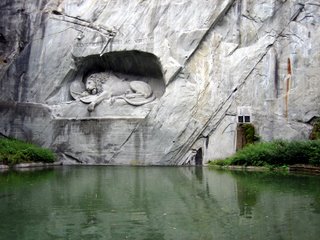
The Lowendenkmal (Lion Monument) is a monument to the bravery of the Swiss Guards who died in Tuileries of Paris in 1792 trying to save the life and honor of Marie Antoinette. Mark Twain once said the Dying Lion of Lucerne was "the saddest and most poignant piece of rock in the world." I have to agree.
We also viewed the Panorama, one of the largest canvases in Europe, covering 10,861 square feet (thanks mom!). Couldn't take a picture inside.


Taking a break at Lake Lucerne...

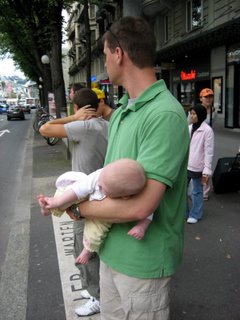
While Chase appreciated the history of Lucerne, she found her toes to be more exciting ...

Historical information provided by Frommer's Switzerland


The lake is the fourth largest in Switzerland (24 miles long, 2 miles wide).

The Kapellbruke (Chapel Bridge) - pictured below - crosses the Reuss River. Built in 1333, the bridge is 558 feet long and one of the best preserved bridges in Switzerland. It was originally used for defense (I laughed when I heard this because I was thinking ..."quick everyone, onto the bridge." Brian, on the other hand, believes it was most likely the only bridge crossing the river). The bridge was also known for its 122 paintings (depicting daily activities) that hung within - from the roof. Unfortunately, 2/3 of the paintings were destroyed in a fire in 1993.


While the paintings below are from Mills Bridge, they are quite similar to the paintings seen in Chapel Bridge. Mills Bridge, on the other hand, was built in 1407 and restored in the 19th century. The series of paintings, called The Dance of Death, commemorate a plague that swept the city. They were painted by Kaspar Meglinger in the 17th century.

The Lowendenkmal (Lion Monument) is a monument to the bravery of the Swiss Guards who died in Tuileries of Paris in 1792 trying to save the life and honor of Marie Antoinette. Mark Twain once said the Dying Lion of Lucerne was "the saddest and most poignant piece of rock in the world." I have to agree.

We also viewed the Panorama, one of the largest canvases in Europe, covering 10,861 square feet (thanks mom!). Couldn't take a picture inside.


Taking a break at Lake Lucerne...

While Chase appreciated the history of Lucerne, she found her toes to be more exciting ...


Historical information provided by Frommer's Switzerland
Saturday, September 02, 2006


Thursday, August 31, 2006


Tuesday, August 29, 2006
Why do rubber bands stretch?

I continue to be amazed at how interested Chase is in what I'm doing. I can actually see her process everything I do, take note, and then file it away.
I've always believed you should address your child with respect, and be especially careful not talk down to them. Tell them what you are doing. Explain things to them.
So we do our best to explain why things float in the bath tub, what shadows are, why it is warmer in the sun, why is the sky blue, etc. I've personally found it to be a good excercize to explain complex concepts as simply as possible.
We were doing pretty well until I came up with the question: why do rubber bands stretch?
The simplest answer I came across is as follows:
"you can think of the polymer molecules (that comprise a rubber band) as a tangled mass of very long spaghetti strands tacked together to one another in a few widely separated places along the strands. When the rubber band is stretched, this tangled mass of "spaghetti strands" stretch out and line up parallel to one another (more or less / mostly less). It is this lining up that allows the rubber band to stretch. However, there is a limit to how much the rubber molecules can be stretched because they are attached to one another in these few places. (The technical name for these links between the chains is "cross linked".) If too much force is applied these cross links will break and the rubber band will "snap". - Vince Caldor, Ask A Scientist (http://www.newton.dep.anl.gov/askasci/eng99/eng99163.htm)
For those of you who are a little more math and science inclined:
"At a constant temperature, and for elongations not too large, a rubber band obeys Hooke's Law: The force, f = - K(X - Xo) where K is a constant, (X - Xo) is the elongation and the sign in negative because the force is in the direction opposite to the extension. That is the force, f, is trying to pull the rubber band back to its equilibrium length, Xo." - Also from Vince.
Vince goes on to say:
"When you heat almost any solid, it expands. But not rubber bands!!! The reason is that heating the rubber molecules make them move around more. They become less aligned as a result and the rubber band SHRINKS instead of expanding when it is heated!!!" (This is quite exciting, as seen from his use of exclamation marks)
But enough about Vince (I found him slightly condescending, but I'm sure it's just because he's one of those super "mathy" types who doesn't understand why everyone doesn't know calculus) and why rubber bands stretch (although I'm sure you're all happy you now have something stimulating to talk about at your next party). I came across a fun Web site while I was doing my research and wanted to share it with you.
Check out: http://www.why-is-the-sky-blue.tv/why-is-the-sky-blue.htm
*Rubber band image courtesy of Wikipedia. The entry on rubber bands is fairly hilarious.
Monday, August 28, 2006
Chasie Magoo and her little cat Schmoo
Chase loves Dr. Seuss so much that I decided to write a story for her. After conducting a little research, I learned that most of Dr. Seuss' books are written in anapestic tetrameter (anapestic tetrameter consists of four rhythmic units (anapests), with two weak beats followed by one strong beat).
So here goes...
There once was a girl
Named Chasie Magoo
She lived in
With her little cat Shmoo
All through the day
That little girl Chasie
And her kitty cat Shmoo
In the middle of May
Kitty cat Shmoo
thought of something new to do
Said the kitty
Come with me outside
I'll show you something pretty
Come along for the ride
And they sat together, looking up to the sky
As they watched the clouds
Change shape up there
Saturday, August 26, 2006
Solids
I hesitate as I write this entry -- the discussion of introducing solids, I have found, is a loaded topic (not unlike the topic of breastfeeding).
Some people feel it is best to wait until the baby is 6 months old (to avoid food allergies and decrease chances of obesity later in life), while others believe it is best to introduce solids when the baby (1) can sit upright with little support, (2) shows interest in food and (3) is at least four months of age.
At Chase's 4-month pediatrician visit, I was told "it's time to start introducing solids" (I felt like I had graduated and was being handed a diploma). Herr (spelling of Herr is intentional - it's German) Doctor recommended I start with carrots, then potatoes, etc. He told me to try a new food each week and look for any sign of allergies. He also recommended introducing a bit of baby cereal as well, once Chase had the hang of "solids." And that was it. He made it sound so easy.
I laughed as I mused what the NHS would say ... "Start with mushy peas, then fish and chips, then Guinness - but be sure to limit it to only one Guinness a day..." - haha.
I figured that if Chase's pediatrician was laid back about it, I would be too (those who know me know that it's nearly impossible for me to be laid back about anything). I believed I was equipped with enough basic knowledge (no sugar, salt, honey, milk, strawberries soft cheese, blue cheese, peanut butter) and common sense (mush it up really well before feeding it to baby) to start "Operation: Introduce solids."
About two weeks in, I was feeling pretty confident, but I still picked up a book that was given to me as a gift (written in America), about how to introduce solids. Since moving to Europe, I have developed a nagging feeling that there is something more I should know (about just about everything) that the Europeans (1) forget to mention, (2) figure I should know, (3) just don't know, or (4) just don't care (see entry for DHA).
Well, I have to say - the book, "Super Baby Food," written by Ruth Yaron, scares me. Sure it has everything a mom needs to know (first aid, meal planners, recipes, nutrition, portion sizes, and more), but it is so packed with information that I'm terrified I'm going to forget things - or do something wrong. I learned, for example, that carrots and potatoes are not recommended as a first food, that wheat is a high risk food, that all fruit should be boiled before it's given to a baby, and that semolina is a high risk allergen (so why do the stores here sell semolina baby food?), that foods should be introduced at the same time each day, that water should follow each introduction, and what allergies to foods may look like (scary stuff) -- and I'm only about a quarter of the way through it.
And, to make things a little more complicated/confusing, add in the fact I'm living in a foreign country, where I don't speak the language and I can barely read the ingredients on boxes (even though they are kind enough to write it in French, Italian and German) ... plus, all measurements are milligrams/grams and no detail is given about the % as it relates to daily allowance.
So once again, I find myself straddling the line (or should I say pond) between America and Europe. As I have not lived in the US for three years, I'm starting to appreciate the laissez-faire attitude that comes with living in Europe, but I certainly don't want to jeopardize my daughter and want to make sure she has a safe and enjoyable introduction to solid food.
After much deliberation between the European and American way of life, I've decided I will read, and re-read this book, memorize it, build out a meal calendar, chart Chase's responses to each food and present it to Herr Doctor at Chase's next visit -- at which point he will look at me like I'm a "crazy American" - but I can take it - I've received the look a lot since I moved to Europe.
I guess you can take the American out of America, but you can't take the America out of the American.

Thursday, August 24, 2006
Question Of The Day
Is my dryer shrinking Chase's clothes or is she really long enough to wear 9-12 month clothing at 5 months of age?
Wednesday, August 23, 2006


Tuesday, August 22, 2006
Kunsthaus
One of the largest portrait galleries in Switzerland - and the first museum Chase has ever seen. She sang throughout our visit, while listening to her voice echo, echo, echo...

Subscribe to:
Posts (Atom)